智联招聘
2 sentenced in China’s first criminal case over leaks of unreleased Genshin Impact and miHoYo game content_我的网站

一 |
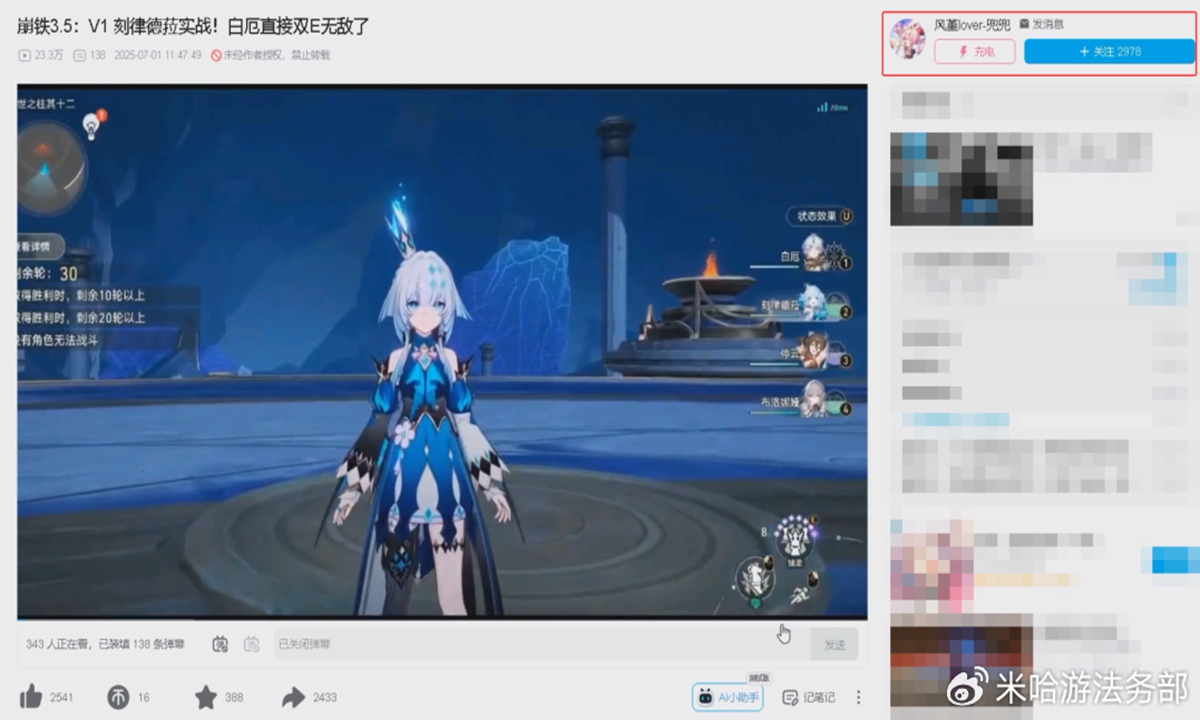
Two Bilibili (Chinese video-sharing platform) users were found guilty of copyright infringement and were sentenced to one year and two months and one year in prison, respectively, both with probation. Photo: Courtesy of miHoYo
A criminal case involving information leaks related to miHoYo, the developer of
Genshin Impact, has reached its first-instance verdict. Two Bilibili (Chinese video-sharing platform) users were found guilty of copyright infringement and were sentenced to one year and two months and one year in prison, respectively, both with probation. It is the first criminal game leak case under a new judicial interpretation issued by China's top judicial authorities, according to miHoYo.
The infringing videos uploaded by Su and Wu received more than 600,000 and 300,000 views, respectively, exceeding the criminal prosecution thresholds stipulated under the judicial interpretation. The court therefore found that the two individuals met the criteria for criminal prosecution and handed down guilty verdicts.
During routine monitoring, in July 2025, miHoYo discovered that Su and Wu had repeatedly uploaded gameplay videos featuring unreleased versions of miHoYo titles, including
Genshin Impact, Honkai: Star Rail and
Zenless Zone Zero, without any authorization from the company. The videos, widely circulated within gaming communities, exposed unreleased characters, skill animations and other content that had not yet been officially introduced to players, miHoYo noted.
After discovering the alleged violations, miHoYo reported the case to the police in accordance with legal procedures. Following an investigation, the police arrested the two individuals involved.
The case was publicly heard and the verdict was delivered on April 24, 2026. The court ruled that Su was to be sentenced to one year and two months in prison with probation, while Wu was sentenced to one year of detention with probation, according to miHoYo.
Guo Hao, a Beijing-based lawyer, told the Global Times on Thursday that a key significance of the case lies in its further clarification of how game leak cases can be assessed under the Criminal Law.
"In the past, game leaks were more often handled through civil infringement claims or breach-of-contract disputes. In this case, however, the court did not simply determine liability based on whether content was released ahead of schedule," Guo said. "Instead, it considered factors including the scale of dissemination, the nature of the leaked content and the impact caused, and determined that the conduct met the prosecution threshold for the crime of copyright infringement."
Similar game leak incidents have also occurred overseas in recent years. In October 2024, The Pokemon Company suffered a data breach that resulted in large amounts of internal information being leaked online, including employees' personal information, according to overseas media reports. Dubbed the "Teraleak" by the gaming community, the incident was reportedly one of the largest game-related leaks in recent years. The leaked materials reportedly included game source codes, details of future projects and other internal information, according to Nintendo Life, a UK-based gaming news outlet.
Earlier, Nintendo had pursued legal action over the leak of a
Pokemon Sword and Shield strategy guide in 2019. According to gaming website Polygon, The Pokémon Company later reached a settlement with the two individuals responsible, who were required to pay $150,000 each in damages.
"From a player's perspective, there is a clear difference between game leaks and normal game discussions," Lu, a member from the Steam gaming community, told the Global Times on Thursday. "Players discussing and analyzing officially released information is part of gaming culture, but obtaining and spreading unreleased content through unauthorized channels can harm the efforts of developers and affect the experience of the entire player community."
Such concerns are also shared by game developers, who view unreleased content as a key part of their creative and commercial plans.
A post by miHoYo on its online account specifies that every unreleased frame of game content represents the design and refinement efforts of its creative teams, while also carrying players' expectations for upcoming updates. Unauthorized early exposure of such content not only infringes upon miHoYo's copyright interests, but also takes away the surprise that players should have when experiencing new content for the first time.
。 中新网拉萨8月21日电 (李林)21日,西藏林芝市波密县委宣传部介绍,波密县充分利用红色资源,开展红色课堂进校园活动。截至目前,该活动已实现全县乡镇中小学、县直中小学全覆盖,累计覆盖师生1400余人次,发放各类学习激励物资600余份。
图为志愿宣讲员在波密县学校开展宣讲。 波密县委宣传部供图
据了解,波密县将红色课堂进校园作为铸魂育人的重要抓手,构建多方联动工作机制。遴选骨干力量组建“波密县红色校园宣讲团”,组织志愿宣讲员下沉全县各级中小学开展系统宣讲。
为切实提升红色教育实效,波密县全面推行“宣讲+检测+激励”工作模式。宣讲员立足用通俗易懂、贴合青少年认知的语言开展授课,帮助学生理清历史脉络、厚植家国情怀。每场宣讲后,围绕核心知识点开展随堂知识检测。还设立课堂互动激励专项经费,对答题踊跃、表现优秀的学生发放纪念奖品和学习文具。
下一步,波密县将持续落实红色课堂进校园常态化工作机制,建强志愿宣讲员队伍,重点培育校园“红领巾讲解员”;不断优化宣讲内容、创新授课形式、完善测评激励体系,引导广大青少年争做守护边疆、建设家乡、担当使命的新时代好少年。(完)
【编辑:王琴】。

二 |
Current article:http://www.zongchaeiwengshuabaisisuofu.sbs/news/20260826_8679.html
Published on:16:47:49